

People between the age group of 25 and 35 are the maximum users of taxi booking app. These people expect any service to give a wonderful experience to them along with the intended service. So the taxi-hailing services must also give an all around riding experience to attract them. If any taxi startups fail to fulfill such expectations, the user will simply move to alternate service. Trying to provide a wonderful ride experience will also be a chance to scale up your taxi startup business. The purpose of your taxi is not only to give a ride between two places but a sense of value to users. How to Scale Up Your Uber-Like Taxi App With These Features? I have explained some features that can be added to your taxi startup. These features are not necessarily related to the app. Small taxi startups can add these features to gain more young users. Let us now see one by one. Music system Music system is available in most cabs of Uber and Lyft. This option can be of much use to young riders because they enjoy music in a car ride. Small taxi startups don’t have much idea about this. They think it is unnecessary for a taxi. Riders who use on-demand taxi to reach office will feel fresh and positive if the day is started with music. To attract more users, you can give personalized music. The riders select the music they want while booking the cab in their app. This only requires a small modification in the app solution. Tipping for drivers Nowadays riders do not hesitate to pay more for a ride that gives them a wholesome comfort. Also, the smooth ride is possible because of the driver. So you can help the driver with benefits like tips. The customer can be allowed to tip the driver in the app itself while paying for the ride. The amount of tip can be standardized or entered manually in the customer app. This is apart from the standard rating and review system. The effects of good rating may or may not give instant benefit to the driver. But the instant tipping can bring an instant change and the driver will work enthusiastically. Save addresses in advance Having no hassles from the start of booking till the end of the ride itself is a good experience for the user. One part which you can bring ease for the user is by giving the option to save the address in advance. Using this feature, the customer can save any no. of address in the app. So that while booking, the current location or destination can be selected with a small tap provided the location is saved. Quick pay using wallet Cash payment, card payment, and internet banking is tedious sometimes and will not suit everyone. But when the wallet is used, the payment can be made with a single click. This wallet option is not present in many small taxi startups. Time is money for many riders. So this quick pay wallet will be liked by many riders and young users. Wallet can be easily integrated with the app by app solution maker. Integrates payment system is also available in the present app solution which consists of wallet along with others. Bid a ride Often many riders think they are paying an exorbitant fare for a ride. Still, from these overpriced fares, very few percentages are sent to the driver. This model is not sustainable for a long time even if it gives you more money as a taxi admin. This problem can be solved using the bidding model. In this model, the user will bid a price for a ride. This will reach to nearby cabs and if the ride is confirmed if any driver accepts the bid. Bidding model gives a win-win situation for the rider and driver. Also, the driver can also make a counter bid which can be accepted or declined by the rider. Ride to your friend Normally in a taxi app, the destination is either entered manually or saved address is used. Now it is possible to get a cab to the rider friend’s location without an address. This is possible when the friend’s no. in the contact list is in sync with the taxi app. When a contact is selected, the taxi app will automatically locate the contact’s phone using GPS and mark it as the destination. This feature is cool and works only when the GPRS features is ‘on’ in the contact’s mobile. The usability of this feature is not practical for many taxis and it is in the testing phase. Bottom line The ideas I have mentioned above is easy to implement and liked by riders immediately. Existing taxi startups can contact their taxi app maker to do these changes. I also hope these changes can give a better experience to riders. Also, young riders don’t hesitate to spend more on something that is worth it. Such creative ideas can also be used by any entrepreneurs who are planning to launch a taxi startup. For them, it is better to choose a good solution provider. I suggest SpotnRides which is a quality taxi app. Integrated wallet, address saving, tip the driver, etc are present already in SpotnRides solution. Very few changes can be made at the request of the client. If you are interested in SpotnRides, please feel free to send doubts and queries to hello@spotnrides.com. Get Free Demo – WhatsApp | Skype
6 Myths Busted About On-Demand Taxi Startup
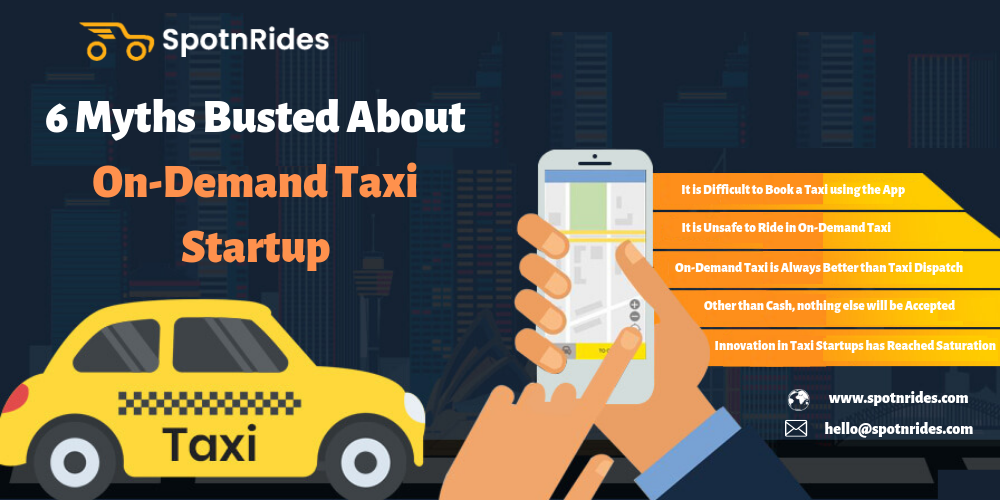
On-demand taxi hailing startups grabbed the attention of many. Not to mention its worldwide reach and entrepreneur’s craze for it. On the other side, we can see some riders and entrepreneurs showing apprehensions towards it. I think it is because of some misconceptions and myths. In this blog, I have tried to clear it with good examples. Let us now see one by one. What are the Myths about On-Demand Taxi Startups? Surge pricing is ‘on’ even after the peak hours It is true that taxis set a very high fare in the name of surge pricing and customers also have shown their dislike towards it. Working people and frequent commuters who cannot avoid booking taxis are being exploited by taxi startups in the name of surge pricing. But, the users have to understand that the surge pricing model works based on an algorithm and this algorithm uses predictive learning to analyze demand. So, when the demand is more, surge fare automatically goes on. This is contrary to the claim that taxi use surge fare even the demand is low. This is a misconception and one thing that can be done to reduce its effect is the surge price can be lowered. It is difficult to book a taxi using the app Some people think that “It may sound easy to say that a taxi arrives at the rider’s location with just a single tap on the mobile, but the reality is different and not all of them can do it seamlessly”. This notion is totally wrong, using taxi app is foolproof. A new mobile user can book a taxi in the first attempt without any hassles. Starting from big to small taxi startups, more effort is put into app development. The taxi app development focuses mainly on giving a flawless performance with a smooth user interface. Obviously, using a taxi app with uninspiring design and problematic interface is difficult. Get Free Demo – WhatsApp | Skype It is unsafe to ride in on-demand taxi There is a preconceived idea among people that taxis are unsafe. Yes, there are many instances of unsafe taxi rides either because of driver behavior or rash driving. But, at present, unsafe rides are a thing of the past. I can say with confidence that it is only because of the tech advancements that made taxi ride safe. Hiding user phone no. from the drivers, notification to check taxi plate no. before riding, location sharing to contacts, and panic button are some features to make a safe ride. These features are made with a small tweak in the app solution. Other major techs like blockchain and data analytics are some reliable ways to check driver background. On-demand taxi is always better than taxi dispatch This would have been cent percent true 10 years back. Back then, Uber came and changed the face of the taxi industry. People also accepted it graciously because earlier dispatch system was inefficient and tiresome to use. Now, things have somewhat changed. Taxi dispatch system is made on par with the taxi startups. Present taxi dispatch system is a combination of app-based booking and taxi management system. This advanced version of the dispatch system is a relief for conventional taxis. On-demand taxi too has some downsides like exorbitant pricing, no manual call booking, etc. These downsides are not in the dispatch system. To be frank, many taxi startups are migrating towards dispatch system after solely working as an on-demand model. Another reason for the transition to dispatch system is decentralization of work and more profit margin. Nevertheless, the craze for on-demand taxi never seems to fade anytime soon. Other than cash, nothing else will be accepted Surely, drivers do take cash but that doesn’t mean only cash will be accepted. Most apps have integrated payment gateway and card payment system in it. So, users don’t have to worry about it. Some startups are accepting only cash payments which is only going to hurt them. Another advantage of digital payment is the money will be directly transferred to the driver’s bank account. Cryptocurrency payment integration is underway but it takes some time to make it mainstream. Innovation in taxi startups has reached saturation On-demand model itself was born out of serious innovation and most of this century’s disruptive technologies were used in it. Data analytics, Artificial Intelligence, Machine learning, IoT, and many more find predominant applications in the transportation sector. New techs emerge and existing ones evolve, this is the reality. So, same as technology, its applications also need to evolve and update constantly. In simple words, innovation never ceases in taxi startups and gaps are filled then and there. Autonomous taxis, Augmented reality navigation, VR driver test, etc are innovations underway in the taxi market. Wrapping up These myths are especially there for entrepreneurs who look to enter the on-demand taxi space. I hope all the preconceived notions are busted with good explanation in this blog. Also, take a look into SpotnRides – taxi app solution for new starters. Some of the above said myths may be true for some taxi apps, but certainly not for SpontRides. We painstakingly developed this from scratch keeping in mind the need and future requirements. Our app exhibits stellar user interface with features like location sharing, mobile no. hiding, and unparalleled UX. Our team also has a pre built dispatch system which can be tweaked to suit any scenario. For more details, tap a message to hello@spotnrides.com. We are looking to hear from you. Get Free Demo – WhatsApp | Skype

How Can a On-Demand Taxi Startup Re-Establish Trust Among Its Users?
Many small taxi startups operating across the globe struggle to get good revenue and this is not necessarily because of very high competition. We have seen many small startups outperforming the bigger ones. Mostly the issue is at the grassroot level and by eliminating it, these startups can regain their lost glory. Now let me give you some info about the reason, Why on-demand market leaders are in the position They Are. Uber taxi booking started small but quickly captured the market with unprecedented growth. In fact, Uber owns none of the cars it operates. Still, it completes millions of rides per day. How is that even possible? The one word answer for this is ‘trust’. Not only Uber, but many other top on-demand firms also work based on trust. Blabla car, a ride sharing firm conducted a survey among its users and found that 88% of them accept sharing only if they get full trust over the profile. The same is the case for Airbnb. This peer to peer renting platform owns none of the space it offers. In Airbnb, the space is rented only based on trust. All these startups are pouring innovations and tech advancements to maintain and improve the trust between them and the users. What’s Wrong with Small and Medium Taxi App Startups? The one factor I mentioned above (Trust) is what lacks in most taxi startups and this is the problem. These on-demand taxi hailing firms do best on a business plan, taxi app solution and completely overlook customer engagement. Below are some list of reasons that can potentially create distrust among customers. Unsecure payment system The digital industries struggled in the last decade to make people embrace paperless payments. This is because people feared about data getting compromised. Such an important process if made unsecure will definitely affect the trust and retention rate. More than the quality of service, this is important. Poor social media activity Smartphones are ubiquitous and more than 75% of users are active on social media. It is easy to reach people and promote on social media. Being inactive and failing to reach out to social media users will take a toll on the startup’s reputation. It is seen that many taxi riders comment and post on social media about their journey and inconveniences. Quick response is required for such queries. Reacting slowly to complaints On-demand taxi startups do get frequent complaints from customers regarding the service, booking, drivers or anything else. This is okay only when such complaints are dealt with quickly. Poor reaction to complaints and queries damages the reliability of the business. It is also found that many complaints on drivers by riders are not noted and left free. These reasons are only the tip of the iceberg. Take time to find out where you are getting wrong. Now, let me give some tips to regain or re-establish customer trust in 5 proven ways. This list is exclusive for taxi startups. Being transparent First, if you want the customer’s trust you need be deserving of their trust. So, starting from acquiring customers, promotion, do what you promised. Please don’t do exaggerated claims and promises that you cannot provide. Be straightforward and honest in what you are going to do. This must start right from pricing, marketing, cancellation policy, customer grievances redressal, etc. Also, get feedback whenever possible from riders, drivers, and all other stakeholders. This tells you how well you are transparent. Branding You can see that a startup service having large user base also have a strong brand. The branding will be such that it connects with the users. This idea of branding and acquiring customers through it really works and to create such a kind of brand, you first give some guarantee to users. For example, Airbnb gives guarantee up to $1 million for its guests. The same way you can give automatic insurance cover to drivers and riders at the time when a cab is booked. This may sound impractical at first but it works. Humanize more Automated language processing and chatbots for customer grievances redressal and customer care may seem advanced and cost effective but nothing can replace human to human interaction. Since taxi startup is powered by people, a humane touch is crucial. A customer care person directly asking the users about ride experience establish a sense of connect to the customers. Rating and review The rating system is seen in almost all taxi startups but the going beyond it you can introduce a written review system. This system is effective only if it is taken seriously. Prompt and polite reply to the reviews is a must. Again, using chatbots to reply to all reviews will backfire. Final say Understand that trust and loyalty are the building blocks of a strong customer base. As a taxi startup, you must always learn and evolve to build an everlasting service. As a maker of quality taxi app solutions, I strongly recommend you to earnestly follow these points. I hope that new people yet to start a taxi firm can also benefit from this article. For them, I suggest SpotnRides – taxi app solution like Uber. SpotnRides has responsive rating & review system, ad management, in-app chat, and many more. I think it will be better if you launch your taxi startup using SpotnRides. To find more details, tap a message to hello@spotnrides.com. Our business team is quick to respond to you. Get Free Demo – WhatsApp | Skype
How SpotnRides Taxi API Helps You and Easily Integrate with Your App at Low Cost?
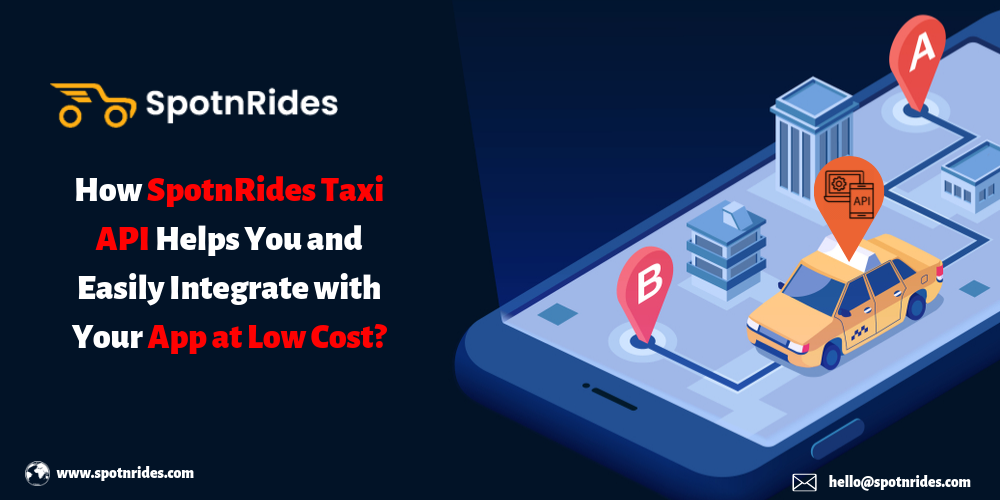
Uber is the no. one taxi booking startup which operates millions of cab worldwide. This app now has an API which is being used by many other applications. This blog explains about Uber API, it’s applications and also about our SpotnRides taxi API, it’s documentation, and many more. Let us see one by one. What is Uber Taxi API? Application Programming Interface(API) is a set of instructions or procedures that enables an application to access the data and features of another application or operating system. This is the simplest definition of an API. Uber API also works similar to a normal API. Normally, an API is used in third-party applications. Even the taxi app Uber uses Google map API to access the Google map for navigation and location data. Same way, Uber API can be used by other applications to access Uber. But, the cost and effort required for integrating Uber API make many startup apps and on-demand apps to go for alternatives. SpotnRides API SpontRides is a taxi app which is prebuilt with all fundamental features and closely resembles Uber. We have made this app for budding entrepreneurs who wants to get into the taxi market at an affordable cost. Now, we have got a brand new API for SpotnRides. We know that there is demand for taxi app API’s and our existing clients felt that they can further improve their business by partnering with third-party apps using API. SpotnRides API has a few documentation and each part can be used for particular work. Let us see about it now. Get Free Demo of Taxi App – WhatsApp | Skype API documentation SpotnRides driver and rider API This API can be used for some innovative on-demand services. It has data which includes payment, ratings, commission, etc. Our rider API can ask for a trip request. This API can be used in any third-party apps where users can ask for a ride with just a tap. The third-party app will get more users if this API is placed inside it. SpotnRides business API This API can do operations and handle data for billing, user management, accounts, payments, etc. Startup apps that require billing and payments functions can use it. New startups can use these APIs to carry out some work effortlessly. For our existing clients, these API’s helps you to partner with others. Benefits of using our API in your business No need to develop a separate taxi app which consumes a lot of time and effort. You just focus on your core business. It is hassle free to integrate our API with your app and partner with any of our clients. Attaching the API can get you some monetary benefits. For example, Uber gives $5 credit for the new user through its API. Retailer shops and startups can solve an additional problem for its customers by getting them a taxi with so much ease. For example, a customer is visiting your shop and finally looks to book a taxi. With our API in your store app, the customer can book a taxi without even typing any location. Customers can also get additional benefits. API service integrated with social media apps will be more effective. Not to mention the total social media usage. Integrating SpotnRides API into your app First, go through the documentation and choose which one is apt to you. Because not all API documentation is used for booking a taxi. Some others are also used for other purposes like billing, accounts, payment, commission, user management, etc Be clear about the platforms like iOS and Android for which you are going to integrate the API. Partner with any of our existing taxi app users for service. Customizations and design changes like placing the taxi booking button and address, etc can be done by our developer’s team. Examples of apps that use APIs Hotstar: Hotstar is a live video streaming app used by millions of users globally. They have Swiggy-food ordering app API in place. So, the users can order food anytime while using the Hotstar app without any interruptions. Swiggy and Hotstart, both benefited from this. Bravo: This app makes it easy to send payments to user’s favorite host, waitress, bartender or musician at the restaurant, bar or club they are going to or on your way home. This app has Uber trip experience API in it. So, the customers can get access to Bravo app while traveling in Uber taxi. Starbucks: Starbucks is a coffee chain in the US and many other countries. A customer enjoying beverages at Starbucks can book a ride with just a click from the Starbucks app effortlessly. Finally, do you really add value by using our SpotnRides API? First, have a clear idea about your business and do market research whether you really need a third-party taxi API. Type of customers for your business/startup decides the need for a taxi API. We as a maker of SpotnRides API have rich experience on on-demand taxi app development. So, you need not worry about the integration of our API with your app. Since our API is used for other purposes other than taxi booking, you can discuss with our team to know our API’s relevance. If your startup requires any of the following functions like trip experience, payments, commission management, user management, billing, etc, you can use our SpotnRides API. Our existing app users can also contact us for the API which we hope will be of much use to your taxi startup. Please contact us on hello@spotnrides.com to discuss the applications of our API and also regarding integration, features, and design. Get Free Demo of Taxi App – WhatsApp | Skype
Kickstart Your Venture with On-Demand Car Wash App Business to Connect Users with Car Wash Technicians
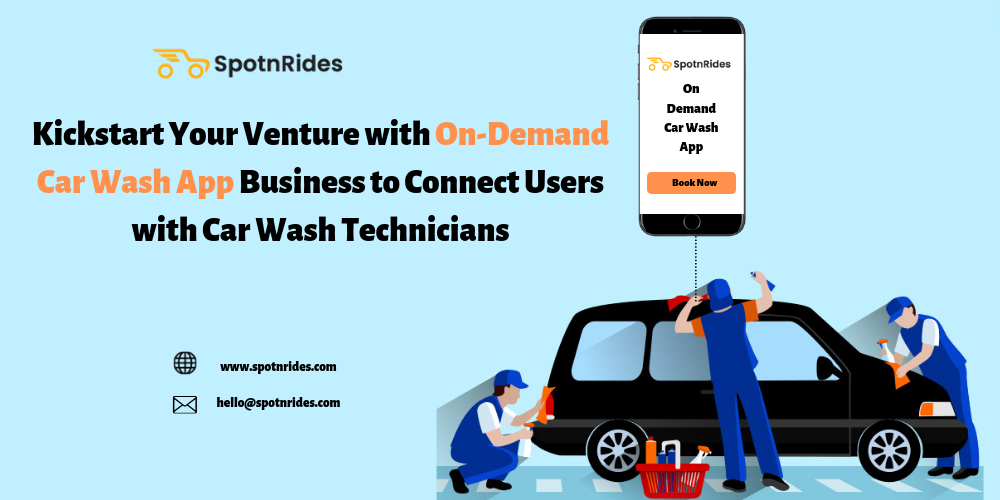
Car wash and car care may seem a simple work but many vehicle owners are finding it frustrating because of the time and energy it takes to do it. Nowadays, people are looking to spend some peaceful time on the weekends and the car wash is ruining it. With the mobile car wash and smartphones available everywhere, there is no reason to ruminate about car care at least now. How car care can be related to more smartphone usage and mobile car wash? It is possible with on-demand app for car wash. Before briefing about it, let me say a few words about on-demand. The on-demand model a.k.a app-based service is known only for the last 10 years. Aspiring entrepreneurs look at the on-demand market as a boon to their entrepreneurial pursuit. It gives immense opportunities and relies more on innovation and creativity than mere capital investment. The on-demand economy is expected to reach $335 billion by 2025. What is On-Demand Car Wash App? Now coming to the on-demand car wash. The on-demand car wash is an exciting opportunity still untapped by potential entrepreneurs. The working model of this is similar to the Uber app. Using the on-demand car wash app, a user can search and schedule a car wash from the comfort of his time. For entrepreneurs and car washing companies This on-demand car wash can be launched as a startup by entrepreneurs where interested car wash companies and technicians can be made to list their service in the app. Every time a user schedules a car wash service, a particular commission is transferred to the admin of the app. This happens in a marketplace model. Car wash companies can also start their own on-demand booking app startup to get more margin. Car wash companies and individuals will get more visibility when their service is listed in the app. It is also estimated that any service will get more sales and revenue when listed online. Apart from app development and bringing more service providers on-board the app, there is not much cost involved in launching this as a startup. Get Free Demo – WhatsApp | Skype How does this app work? User registers the details and login into the customer app. Search and select a suitable car wash from the list. Book and schedule the time for a car wash by giving address. The service provider will get the request in his app and use GPS navigation to locate the customer place. After the service, the payment can be made using cash or cashless modes. The admin gets a percentage as commission. Top features of this app Online chat: The user can chat with the customer care for any queries or chat directly with the service provider. Vehicle history tracking: The service provider can track the history of the car to get an idea about the type of wash, precautions, and items that should be forbidden from usage. Online payment: With integrated payment integration, payments can be done online effortlessly. Upload car picture: After the service, the car wash provider can take a snap of the car and post it online. Managing technicians and services: The admin can manage the technicians and services from the admin dashboard. Registration of service providers: When a service provider registers, the admin can verify it and accept or decline it. Existing on-demand car care startups Spiffy This is an online marketplace which connects users with car wash technicians. Apart from car wash many other services like oil change, repair, and detailing can be accessed. This startup currently operates in four US states. Only professional technicians will be able to register their name. It raised $30 million in five rounds of funding. Cito car wash This startup provides three kinds of wash services. For referrals, this app gives 10% off. Plenty of add-on services like Armor All, Armor All On Dashboard, Leather Conditioner, Wax, Clay Bar Treatment, Shampoo Carpets, Shampoo Seats, etc. This startup currently operates from the US. SpotnRides on-demand car wash app I hope you have a brief idea about the on-demand car care business. Now coming to the app solution part. The app solution is available as a minimum viable product with all necessary features as SpotnRides. Entrepreneurs and car wash technicians who are interested in launching this startup can use the readymade SpotnRides app to reduce cost and effort. Don’t worry about the app solution, it can be tweaked in every possible way to suit your idea. You need not have any technical background to launch this app. The makers of SpotnRides will assist you from start to deployment and maintenance. Our expert team in designing and development can give a new essence to the app in terms of performance and UI/UX. You can also ask any doubts and queries regarding SpotnRides anytime to hello@spotnrides.com. We are keen to partner with you for an exciting startup idea. Get Free Demo – WhatsApp | Skype

How an Inappropriate Tech Stack of the App Solution Is Detrimental to Your On-Demand Taxi Startup?
The on-demand taxi startups are revolutionizing life around the world. Aspiring business people are looking to make full use of this by launching similar startups in their region. The first thing they start with is app development. The app establishes a connect with the users and it can’t be compromised. The type of technology stack influences the quality of the app and an inappropriate one may do irreversible damage to the app. Here I have explained what to do and what not to do while choosing the tech stack. Before going into it, let us look at some basics. What is a Tech Stack? The various tools and frameworks which is made up of programming languages are the technology stack of the apps. These apps are used as both mobile apps and web apps. Mobile apps and web apps require a different set of tools. Platforms like iOS and Android, on the other hand, are made with different programming languages. Technology stack is a broad term which is used to power the back-end and front-end. Front-end is what you see in the app screen and as web panel. Changes made in the back-end is reflected in the front-end. Back-end The back-end is typically in the server side which is not explicitly visible and it powers the front-end. Back-end houses the operating system, database, server, and app system. For example, a typical back-end of an app is made of MongoDB, Node.js, Angular.js, Express.js. There are many stacks available. Front-end The front-end comprises everything that is shown on screen such as design on mobile application, and web application. Why you need an apt technology stack? See, for example, your app is made with a server with is efficient but spirals down to the ground when handling high traffic. This slow downs the app and sometimes lead to crashes. Such a situation will affect the reliability of the app and users will move to competitors. With the right tech stack, bugs and issues can be quickly sorted without much time and the overall performance of the app will be promising and exciting to use. On-demand apps are subject to various updates and revisions after it is made live. So the technology stack should be flexible and open to modification. More importantly, it should seamlessly react to any changes. Get Free Demo – WhatsApp | Skype Downsides of having an inappropriate stack Misfit tech stack may prove detrimental to your startup in the long run. There is a common misconception that latest tech stack is appropriate, but it is not. Latest tech stack faces a lot of updates which means there will be frequent changes to be made in the codebase. For apps which forms the core of startups, this kind of frequent change is not recommended. Time and resource will not be properly used and a lot of wastages can happen. How to choose the right tech stack? Now let us see how the selection of tech stack for your startup should be made. Whatever type of startup may launch but, in the start, you should focus on developing a perfect app as a minimum viable product. After that, according to the on-demand service type it can be customized. The base should be strong first. Any language or framework that gives a working solution in the shortest possible time is good. For the web app, I recommend WordPress which does not require much technical knowledge. Requirement Before selecting the stack for making an MVP, you must know the exact needs. Try to address some questions like, Does your on-demand taxi app face large traffic? What is the server requirement? How should be front-end? And many more. A typical on-demand app must prioritise user experience and UI design. The scalability of the app is based on the type of usage estimated by you. Angular and React are recommended stack for on-demand apps. Full idea about the needs helps in quickly finalising the tech stack. Resources at your disposal Developers and designers are the one who are going to work on the technology stack and getting developers require money. Uncommon tech stacks are hard to be worked because of the difficulty in finding the developers. Even if they are found, the price for it will be high. So, pick a stack that has a dynamic developer community and also one which has a good future scope. Development and maintenance The cost of development is different for various tech stacks and it is totally based on the demand for the developer. For example, Python, Ruby, and Swift developers cost more than Java, and Kotlin. The cost doesn’t stop with the development and it continues till customization and maintenance. Customization cost totally depends on the type of features and addons. Maintenance is mandatory and this cost can be minimized by using packages from experienced solution providers. Updation of the solution is part of the on-demand startup and open source technologies can be utilized for it to save money. Third party integration The tech stack you choose must allow third party integration. Otherwise, you have to rework on the framework and programming language. Some third party integrations are GPS maps, payment system, etc. These are integrated in both mobile and web app. Testing & security Normally, the on-demand app goes through beta testing and prototyping. Based on tech stack, the type of issue may differ which directly affects the time for testing. Do security checks on both the front-end and back-end. Security checks will let you know the reliability of the app. Conclusion At the end of the day, it is you who has to pick the right tech stack by analyzing your needs and wants of your startup. If you are still confused with choosing the right stack, I would strongly recommend you to use SpotnRides. SpotnRides is a prebuilt taxi app with apt technology stack made for on-demand startups. Our developer team has made SpotnRides as a perfect MVP. So, SpotnRides can be customized and

How SpotnRides Provides Breakthrough Taxi Management Software to Satisfy the Demands in Taxi Industry?
Being from the taxi industry I have to say that both taxi startups which use on-demand booking apps and conventional taxi firms are facing obstacles which are not common to both of them. Obstacles in the taxi business industry For conventional taxi firms, the advent of on-demand taxis changed their operations and made them less relevant in the market. These conventional firms too were resistant to allow some changes like GPS navigation, mobile based booking, cab locating, review and rating system, and many more. The cost of managing the taxis also increased drastically because unlike taxi startups, conventional firms owned all the cabs. Now, in the case of taxi startups, only the small and medium are affected. They face obstacles like intense competition and a lower rate of technology adoption. Also, because of the low margin per ride in the on-demand taxi, many are looking to run own taxis instead of attaching to maximize profits. How Taxi Management Software can Solve the Problem? I said that both the taxi startups and conventional taxis are facing problems which I think can be mitigated by using the taxi management software. Taxi management software is nothing but the latest version of taxi dispatch system with a heavy incorporation of technology. Apart from the taxi booking app, a centralized vehicle management system is present in this software. So, both taxi startups who need to run own taxis and conventional firms can benefit from this software. At the end of the day, it is a win-win situation. On-demand taxi startups boasted of zero inventory model but it backfired for many in the form of less margin as competition increases. With the taxi management system in place, it is possible to run a combination of conventional and on-demand taxi and be profitable. Conventional firms can regain their lost shine with less cost by simply adapting to the taxi management system. SpotnRides taxi management software SpotnRides have long been in the field of developing software solutions for taxi industry like on-demand taxi booking apps and now a brand new taxi management software. Over a period of time, we sensed a change in the working of small and medium taxi startups and after a lot of deliberations, market research, and talks with existing owners, we came up with management software. Our software can be used by riders for hassle-free booking from anywhere and anytime. All the features are well-upgraded keeping in view the latest advancements. The vehicle management system makes it easy to dispatch the cabs with so much ease. The admin can oversee all the bookings and dispatches from PC or mobile or anything else. Now I will list the top features in SpotnRides software. Phone number protection Riders have the feature to hide the mobile no. from the drivers. Pick up points Riders can select the pick up points from their app. Call bookings If the GPS is not working or even if the user doesn’t have the app, riders can book via calls. Complete ride details Current location of cab, vehicle color, and no., driver no., name, etc are shown to the rider. Demand map Drivers can view the place with maximum demand. Referral rewards Customers can receive offers and rewards for referrals. We think from customer perspective Our SpotnRides apps are already used by many startups across the globe which helped us to get feedback after usage. Thinking from the point of view of customers help us know the behavioral shift and the factor that makes customers display certain emotions. Our product makes the customer feel comfortable because of the smooth user interface and excellent user experience. Our taxi management solution is flexible and whenever there is room for improvement, it is carried out without hesitation about money and effort. Taxi app users’ pain points are well articulated and addressed by constant communication with the clients. Built with the latest technologies Stripe, Paypal SDK, Braintree are used to develop the payment system in the app. We have the SpotnRides taxi management app for both iOS and Android. Java and Kotlin languages for Android and Swift language for iOS are followed for app development. Node js, Python, Ruby on Rails, and PHP are used for backend programming. We generally prefer Native app development and any demerits of using it are well handled by our developer team. Wide range of devices with different screen sizes are compatible with SpotnRides. Wrapping up There is more to say about our taxi management software. Conventional taxi owners and taxi startups who want to add taxi management system can approach us for our solution. The features mentioned above are just to show a glance for you. Brace yourself for the second disruption in the taxi industry and we are also happy to partner with the right entrepreneurs for our growth. Please don’t hesitate to send us an email to hello@spotnrides.com. Any kind of queries and doubts will be answered by our team anytime. Get Free Demo – WhatsApp | Skype

[Infographic] Why this World is Moving Towards the On-Demand Industry? Getting Rich or Gaining Popularity or Leaving a Mark in History
The first modern taxi appeared in the streets of London in the 1800s. Then the taxis transformed as an industry and spread to all parts of the world. Some 10 years back this industry was disrupted by a company name Uber. Uber introduced the app-based booking concept. Uber harnessed the potential of smartphones and the internet. Since then, the app-based model became popular and is being applied to many services that were desperate for innovation. Using an app, the users can access the service anytime and anywhere and hence this app-based service is also known as on-demand service. The entrepreneur community too were enthusiastic in entering this on-demand space. Here at SpotnRides, which is a leading on-demand domain expert has prepared a detailed infographic on why everyone is moving towards the on-demand industry. This infographic has answered the drive that makes one to pursue the on-demand business, whether it is Getting Rich or Gaining Popularity or Leaving a Mark in History. The infographic also gives insight about the market share of on-demand services, the mindset of employees working here, and popularity among people with stats. Also, this infographic explores the breath of the on-demand industry by explaining the various domains, different revenue models, and present market scenario. Some truths about these startups are also quoted with facts. Check out this infographic and finally don’t forget to look into our products at SpotnRides. Get Free Demo – WhatsApp | Skype

Why Geofencing Is Necessary for Your Taxi Startup and How to Test This Feature in Your Taxi App Solution?
Once you have launched a brand new taxi hailing startup, you need to focus on customer acquisition and retention. There are many conventional ways of doing this, but in the fiercely competitive taxi market, it won’t work. Some innovative methods must be applied to do it. For example, some top taxi startups earnestly use features like geofencing for customer engagement and retention. Here, I am going to explain about geofencing and why it is necessary for your taxi hailing startup. Also, I have provided a step by step approach to test this feature in your taxi app solution in case you are in the stage of live testing. First things first, before diving deep into it, let me tell you what exactly is geofencing. What is Geofencing in Taxi App solution? Geofencing is a feature used by mobile app firms whether it is on-demand or anything else. Geofencing refers to a human-defined geographic area ( polygon in geometry terms) on the Earth’s surface. This feature is used in taxi apps for geographical location based configuration. By defining a specific area, it is possible to engage with the taxi app users in that area effectively like sending mass notifications regarding new products & offers, implementing surge pricing in areas with maximum demand, special price for airports, and many more. This is a timely and innovative marketing ploy to attract customers and retain existing users. To the question whether this feature will be effective or not? 80% of the users feel that they are happy with location based targeted messages. 60% of the population anticipate location based notifications and in that 40% people utilize it immediately. Get Free Demo of Taxi App – WhatsApp | Skype Benefits of geofencing in your taxi startup Personalized customer engagement If you are sending a notification on airport taxi discount to users outside the airport, they would get frustrated and this will damage your firm credibility. With geofencing, such problem is a thing of the past. You can send personalized experience to the users by knowing what can attract them. Saving money This is an obvious advantage of using geofencing. Normally, a firm spends a significant amount of money for promotion and customer retention. But, the geofencing feature can have a dramatic effect on users at very little cost. This will be a great advantage for entrepreneurs who are bootstrapping their taxi startup. Rich data collection On-demand startups rely more on data than any other industry and taxi startups are no different. Having data about consumer behavior can be helpful to design better and personalized products. Marketing can also be made focussed without wasting resources. Giving a perfect example of this will make you clear about geofencing. Let us take the case of Uber. Geofencing in Uber Uber first implemented the geofencing feature to identify airports to notify people in airports about available cabs and special offers on booking. This is something different from what was done before. Eventually, Uber applied this feature to many other areas. Testing geofencing feature in your taxi app solution I hope most of them who are yet to launch small and medium taxi startups are relying on Uber like taxi app clone script. In the taxi script, it is easy to integrate this feature and it is more important to test. We as a maker of taxi app solution – SpotnRides, will embed this feature into our script as per the customer preference. Now, we try to explain step by step to test this app solution for surge pricing for a particular region. First, install the setup and launch the admin panel. In the admin panel dashboard, you will see the geofencing feature. Step 1: Now, set up a username and password to register. Next login into the admin panel. Step 2: You have to now go to the pricing setup to configure pricing for a particular area. You can do this in the side panel of the geofencing where you can add or view existing pricing setup. Step 3: The admin can now use the action button in the pricing setup to reconfigure like add or delete. Also, the admin can re-enter the details if needed. Step 4: To add new pricing setup, the admin has to select the new pricing setup option. Then opens a new tab. Here, the admin can add a new location, vehicle type, base fare, and many other variables can be added. Step 5: To view and modify the type of vehicles assigned for a particular region, the admin can do it using view all vehicle types in the admin sidebar. After making all the changes, the admin can save the changes and all the entries will be updated soon. This way you can test the geofencing feature using various other configurations like sending offers, notifications, new services, etc. If you are about to enter the on-demand taxi market and looking for a fully loaded taxi app along with geofencing, then SpotnRides will best suit you. We have provided our app along with geofencing to many entrepreneurs and businesses across 10+ countries. We will also provide constant support for you even after sales till you are completely familiar with all the functions. Please don’t hesitate to tap a message to hello@spotnrides.com for doubts and queries. We are waiting to answer you anytime. Get Free Demo of Taxi App – WhatsApp | Skype
How Will We Implement Surge Pricing in SpotnRides Based on Client Request?
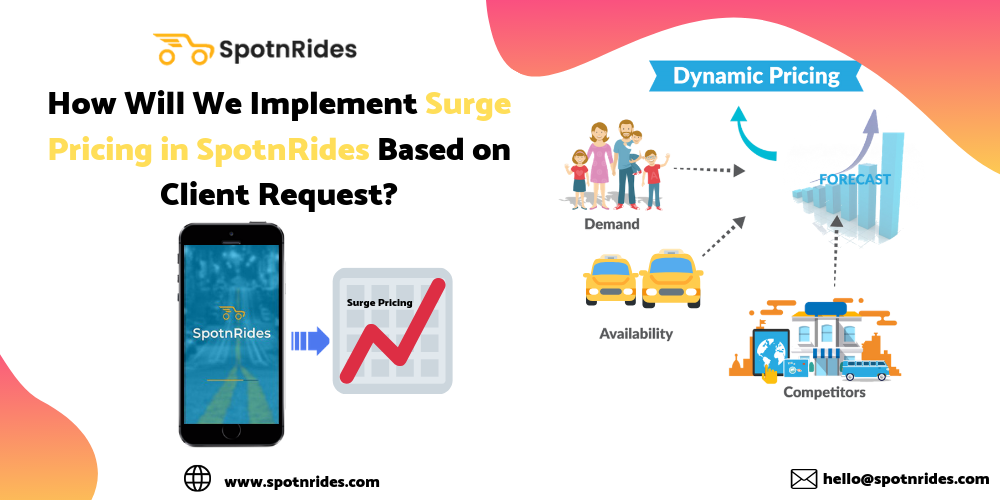
Surge pricing is a concept introduced by top taxi startups. Soon after it, many small and medium startups started to use this feature. Even, yet to launch taxi hailing firms are willing to add this feature to their taxi app solution. SpotnRides, which develops taxi apps to many startups explains how surge pricing is implemented and the methodology it follows to calculate it. Read this till the end to know how. How is Payment Done in a Taxi App Startup? When you take a taxi-hailing startup like Uber or anything else, the rider first gets an estimate of the fare before the ride and if the rider is okay with it, the ride starts and the fare is paid after the completion of the ride. The type of payment can be cash or paperless transaction like debit card, UPI, and e-wallet. The fare estimate for a ride is based on the standards set by the taxi hailing firm. The standard can be anything like rate per kilometer or per unit time or a fixed rate for a ride. For example, Uber calculates its fare as mentioned below. Base fare – A flat fee charged at the beginning of every ride. Uber charges $1 for each booking. Cost/minute – How much you are charged for each minute you are inside the ride. Cost/mile – How much you are charged for each mile of the ride. Booking fee – A flat fee is collected and mostly it is to cover Uber’s operating costs. Here’s how Uber uses the 4 main criteria above to calculate your fare: Base Fare + (Cost per minute * time in ride) + (Cost per mile * ride distance) + Booking Fee = Your Fare In our SpotnRides taxi app solution, the taxi fare estimation is in-built. Also, the taxi fare is calculated based on the standard provided by the clients. We also have ready made provision to calculate fare similar to Uber. Now coming to surge pricing What exactly is it? In layman terms, surge pricing is the practice of charging more for a product or service during periods when it is in high demand. This feature was first introduced by Uber in many metro cities and slowly it is spread to other on-demand services. The surge pricing concept is also known for facing severe backlash from the riders because the taxi fare will increase by 1x or 2x or 3x than the fare on normal days. Fortunately, this surge fare will be displayed on the customer booking app. To escape from the surge pricing, riders have to wait and book another ride. SpotnRides also has an optional surge pricing feature. In our solution, surge pricing can be changed by the admin from the admin web panel. Its working The surge pricing turns on based on the location of the rider’s pickup location. When the driver gets a request from a rider and it is not a surging area, the surge pricing will not turn on even the driver’s location is surging. If the rider’s pickup location is from a surge area, the trip screen displays surge multiplier to the driver. Surge pricing is applied to the base fare, rate per unit time, and rate per unit distance. It will be more clear with an example:- If the fare is surged by .5x, the net fare is calculated as, Base – $2 Rate/time – $5 Rate/distance – $5 Gross fare – $12. Net fare after surge – $18. Other charges – $1. Gross fare – $19. Get Free Demo – WhatsApp | Skype How SpotnRides implements surge pricing? As already said, we already have the surge pricing feature with us and it is very much similar to that of Uber. We have a default method of surge pricing in our solution and it can be easily altered on client request. The surge pricing in SpotnRides works as follows as an example. When more than three cabs are present in the rider’s location, surge pricing will not go on. If less than three cabs are present in the rider location, automatically the rider fare is calculated using surge multiplier. This feature in SpotnRides app can be made completely transparent. For example, the surge amount will be displayed along with the fare estimate. Also, the time up to which this surge pricing is in place can also be mentioned in the customer app. This is to inform the waiting time to book a cab at a normal rate. A multiplier symbol along with the rate to which it increases will be displayed on the screen. For example, the fare is $10 and after surge pricing, if it is $15. “1.5x” will be displayed. Factors other than the no. of cabs we take into account for surge pricing are weather, traffic, peak hours, weekends, natural events, etc. See, although the method we follow for surge pricing is almost similar to Uber, we do have some differences in the factors that set the surge. The no. of cab in the rider’s booking area is taken into account which is not the case of Uber. We have applied this feature to many of our clients and so we know about the different factors that can influence surge pricing. So, at SpotnRides, we are open to apply different factors to set the surge pricing and it is completely doable because of our app development expertise. The client who approaches us should articulate regarding the factor to determine the surge pricing. Wrapping up Still not satisfied with the details shared above? Quickly tap a message to hello@spotnrides.com and get in touch with our business team to know more about SpotnRides taxi app solution and other optional features like surge pricing. We will be happy to partner with enthusiastic entrepreneurs who are keen to enter the on-demand taxi market and provide technical help through our solution. Get Free Demo – WhatsApp | Skype
